
Pharma Group
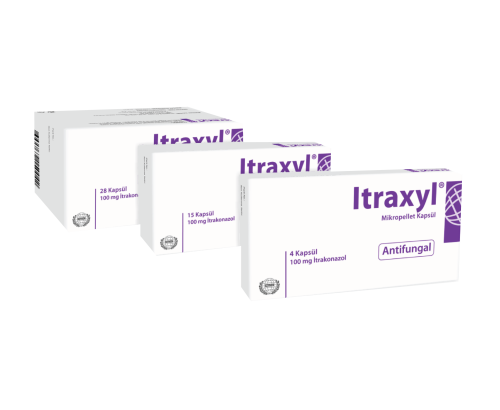
Itraxyl
Itraconazole is an antifungal agent that acts against fungi. Itraconazole affects the permeability of the membrane surrounding the fungal cell, causing the cell contents to leak out.
Itraconazole treats fungal infections in various parts of the body, including the lungs, mouth, throat, eyes, female external genitalia and vagina, back, joints, bones, toenails, and fingernails. Itraconazole may also be used for other therapeutic purposes not listed here.
Product Information
- • Product: Itraxyl
- • Active Ingredient: 100 mg itraconazole
- • Legal Form: 4 / 15 / 28 capsules
Frequently Asked Questions
Does Itraxyl have adverse effects on liver function?
Such concerns may stem from long-term use of Itraconazole—the active ingredient in Itraxyl—within conventional treatment approaches, particularly for dermatological fungal infections. However, pulse treatment with Itraxyl does not adversely affect the liver. In a 2002 clinical study, researchers monitored AST, ALT, alkaline phosphatase, and total bilirubin in patients undergoing pulse treatment with Itraconazole; the drug was found to be safe for the liver.
Is Itraxyl used in the elderly?
Questions of this nature may arise due to potential drug interactions associated with itraconazole in elderly patients undergoing polypharmacy (the use of multiple medications). There are no contraindications to using Itraxyl in the elderly. Clinical studies have also evaluated itraconazole's suitability and efficacy in this population. Itraconazole is effective and safe for use in the elderly.
How is a treatment course administered? Why should a treatment course be chosen?
Once itraconazole is established in the tissue, it is eliminated through the tissue's natural turnover. Thanks to its highly keratinophilic and lipophilic properties, itraconazole remains in the target tissue for an extended period, enabling "pulse" therapy. Pulse therapy is a treatment regimen that reduces both the total amount of medication administered and the overall cost by leveraging the drug's prolonged tissue retention. A single pulse treatment cycle consists of taking 400 mg/day (2 capsules twice daily) for one week, followed by a three-week break. For dermatological fungal infections such as onychomycosis, this approach offers effective, safe treatment with reduced drug exposure and a shorter duration; it replaces the conventional long-term approach—which requires monitoring liver enzymes—with an itraconazole pulse regimen that eliminates the need for such testing.
Could you compare the efficacy of Terbinafine and Itraconazole in the treatment of onychomycosis?
An antifungal agent that remains in infected tissue at therapeutic concentrations for an extended period ensures effective treatment. Itraconazole persists in nail tissue for 9 months, while terbinafine persists for only 6 months. Furthermore, a clinical study of onychomycosis treatment reported a clinical cure rate of 77% in patients treated with an itraconazole regimen, whereas the rate was only 68% in patients taking 250 mg of terbinafine daily for 3 months. Additionally, the study found a 12% treatment discontinuation rate due to side effects among patients using terbinafine, while no patients in the itraconazole group discontinued treatment.
What are the drug interactions of terbinafine?
In vitro studies have shown that terbinafine inhibits CYP2D6 (Cytochrome P450 2D6)-mediated metabolism. CYP2D6 is a Cytochrome P450 enzyme responsible for the oxidative metabolism of approximately 25% of drugs. It plays a role in the metabolism of many drugs with a narrow therapeutic index; consequently, its inhibition can lead to therapeutic failure or an increased risk of toxic reactions. Caution is required when terbinafine is used concomitantly with drugs metabolized by this enzyme, such as tricyclic antidepressants, beta-blockers, and SSRIs (selective serotonin reuptake inhibitors). As is evident, the drugs that interact with terbinafine are widely used in our country. Furthermore, terbinafine is used for long-term treatment of dermatological fungal infections. Careful monitoring is necessary for patients undergoing polypharmacy—the concurrent use of multiple medications—during these prolonged treatment courses.
How is Itraxyl used in the treatment of oral candidiasis?
For the treatment of oral candidiasis, Itraxyl should be administered at 100 mg once daily for 15 days.
How should Itraxyl be used in conjunction with antacids and PPI-class drugs?
Itraconazole absorption decreases when gastric acidity is reduced. If Itraxyl must be used with drugs that reduce gastric acidity—such as antacids and PPIs (proton pump inhibitors)—it is recommended that these drugs be taken at least 2 hours after Itraxyl.
Can pregnant women use Itraxyl?
Patient monitoring is not required for patients treated with an Itraxyl course of therapy. For patients receiving continuous terbinafine treatment, it is necessary to monitor complete blood counts and liver enzyme levels (AST, ALT) at 4- to 6-week intervals.
Is patient monitoring necessary during the use of Itraxyl?
Patient monitoring is not required for patients treated with an Itraxyl course of therapy. For patients receiving continuous treatment with terbinafine, it is necessary to monitor complete blood counts and liver enzyme levels (AST, ALT) at 4- to 6-week intervals.
Why is it important that Itraxyl has a broad spectrum of activity?
Identifying the pathogen in both gynecological and dermatological fungal infections is often difficult. When the pathogen cannot be identified, Itraxyl is the treatment of choice due to its broad spectrum of activity. Thanks to its broad spectrum, Itraxyl provides effective treatment for mixed infections.
What is the starting age for Itraxyl in pediatric patients?
Because clinical studies on the use of itraconazole in children are limited, its use in children is not recommended unless the potential benefit outweighs the potential risk. The literature includes information on certain pediatric daily dosage regimens administered when deemed necessary by the physician.
Is partner treatment necessary when treating gynecological fungal infections with Itraxyl?
Treating the partner is not required for vaginal candidiasis. The clinical community does not support treating the partner for gynecological fungal infections. The primary routes of transmission for gynecological fungal infections are the individual's normal flora and the gastrointestinal tract, rather than sexual intercourse. Partner treatment is not necessary when treating gynecological fungal infections with Itraxyl; however, the attending physician may choose to treat the partner depending on the patient's specific situation.
Can Itraxyl be used for chronic and recurrent gynecological fungal infections?
Clinical studies demonstrate the efficacy of Itraconazole in treating chronic and recurrent gynecological fungal infections. While treatment protocols vary across studies, the generally recommended regimen involves an initial dose of 2 capsules twice daily for one day, followed by a prophylactic regimen of 2 capsules twice daily on the first day of each menstrual cycle for six months. At the conclusion of this six-month course, clinical and mycological cure rates of up to 85% were observed with Itraconazole in cases of chronic and recurrent vaginal fungal infections. These studies support the use of Itraconazole for chronic and recurrent vaginal fungal infections. However, the approved product information (package inserts) for Itraconazole-containing products does not currently include specific dosage instructions for this indication. We can share these scientific findings—based on the medical literature—with physicians inquiring about the efficacy of Itraconazole for chronic and recurrent vaginal fungal infections.
How should Itraconazole and Ornidazole be selected for the treatment of mixed vaginal infections?
Mixed infections involve the simultaneous presence of multiple pathogens, such as bacteria, protozoa, and fungi. When ornidazole and itraconazole are used together, the generally accepted practice is to administer itraconazole according to the 1-day (2×2) dosage regimen for vulvovaginal candidiasis, while administering ornidazole as a 5-day treatment (2×1).